Supernova
| Supernova | |
|---|---|
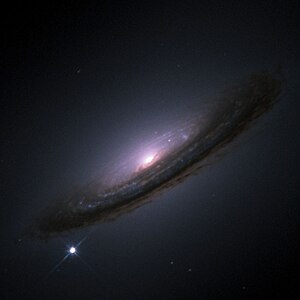 SN 1994D, a Type Ia supernova in galaxy NGC 4526 | |
| Type | Stellar explosion |
| Classification | Type I (no hydrogen) / Type II (hydrogen present) |
| Progenitor | Massive star (>8 M☉) or accreting white dwarf |
| Remnant | Neutron star, black hole, or diffuse nebula |
| Peak luminosity | Up to 10^43 erg/s (comparable to an entire galaxy) |
| Galactic rate | ~1.6–4.6 per century |
| First recorded | SN 185 (AD 185, Chinese astronomers) |
| Coined by | Walter Baade and Fritz Zwicky (1931) |
A supernova (plural: supernovae) is a powerful and luminous stellar explosion that occurs during the final evolutionary stages of a massive star, or when a white dwarf in a binary system is triggered into runaway nuclear fusion. The peak optical luminosity of a supernova can briefly outshine an entire galaxy, releasing as much energy in a few weeks as the Sun will produce over its entire 10-billion-year lifetime.
Supernovae are classified primarily by the presence or absence of hydrogen spectral lines. Type II supernovae show hydrogen and arise from the core collapse of massive stars, while Type I supernovae lack hydrogen and include the thermonuclear destruction of white dwarfs (Type Ia) and the core collapse of massive stars that have lost their hydrogen envelopes (Types Ib and Ic). These explosions are the primary cosmic factories for elements heavier than oxygen, dispersing them into the interstellar medium where they become incorporated into new stars, planets, and ultimately life.
The last supernova observed in the Milky Way was Kepler's Supernova (SN 1604) in 1604, though several supernovae have been observed in nearby galaxies since, most notably SN 1987A in the Large Magellanic Cloud. Modern astronomical surveys now discover thousands of supernovae annually in distant galaxies, providing critical data for measuring cosmic distances and studying the expansion history of the universe.
Classification

Supernovae are divided into two broad spectral classes. Type I supernovae show no hydrogen lines in their spectra, while Type II supernovae exhibit prominent hydrogen lines. This classification scheme, developed by Rudolph Minkowski in 1941, was later refined to reflect the underlying physical mechanisms.
Type Ia supernovae lack both hydrogen and helium, but show a strong silicon absorption line at 635.5 nm. They result from the thermonuclear disruption of a carbon-oxygen white dwarf that has accreted matter from a companion star until it approaches the Chandrasekhar limit (~1.44 M☉). Because they explode at a nearly uniform mass, Type Ia supernovae have remarkably consistent peak luminosities, making them invaluable as standardizable candles for cosmological distance measurements. The 2011 Nobel Prize in Physics was awarded to Saul Perlmutter, Brian Schmidt, and Adam Riess for their discovery of the accelerating expansion of the universe through observations of distant Type Ia supernovae.
Type Ib and Type Ic supernovae lack hydrogen but show helium (Ib) or neither hydrogen nor helium (Ic). They are core-collapse supernovae from massive stars that have lost their outer hydrogen envelopes through strong stellar winds or binary interaction. Type Ic supernovae, particularly the broad-lined variety, are associated with long-duration gamma-ray bursts.
Type II supernovae show hydrogen and are further subdivided: Type II-P (plateau light curve, the most common), Type II-L (linear decline), and Type IIn (narrow emission lines from interaction with circumstellar material). All result from the core collapse of massive stars (initial mass >8 M☉).
Core-Collapse Mechanism
Core-collapse supernovae begin when a massive star exhausts its nuclear fuel. The star's core, now composed primarily of iron-group elements, can no longer generate energy through fusion because iron has the highest binding energy per nucleon. Without outward radiation pressure to counteract gravity, the core collapses in less than a second.
As the core implodes, its density reaches nuclear densities (~2.8 × 10^14 g/cm³), causing the infalling material to bounce off the now-incompressible core. This core bounce generates a shock wave that propagates outward. However, the shock initially stalls as it loses energy dissociating heavy nuclei. The explosion is revived by a flood of neutrinos — ghostly particles that carry away 99% of the gravitational binding energy of the collapsing core. A small fraction of these neutrinos deposit energy behind the stalled shock, re-energizing it and driving the star's outer layers outward in a spectacular explosion.
The core collapse leaves behind a compact remnant. If the progenitor star had an initial mass between about 8 and 20 M☉, the remnant is a neutron star — a city-sized sphere of nuclear-density matter, often observed as a rapidly spinning pulsar. For stars above roughly 20 M☉, the remnant collapses directly to a black hole. The exact mass thresholds depend on metallicity, rotation, and magnetic fields.
Thermonuclear Supernovae (Type Ia)
Type Ia supernovae arise from binary systems containing a carbon-oxygen white dwarf that accretes matter from a companion star (either a main-sequence star or another white dwarf). As the white dwarf's mass approaches the Chandrasekhar limit, the central density and temperature rise until carbon fusion ignites. Unlike stable stellar burning, this ignition occurs under degenerate conditions, leading to a thermonuclear runaway that completely disrupts the white dwarf.
The explosion proceeds as a supersonic detonation or a subsonic deflagration that transitions to a detonation. Within seconds, the white dwarf is entirely incinerated, producing about 0.6 M☉ of nickel-56, whose radioactive decay powers the supernova's optical light curve. The characteristic light curve of a Type Ia supernova — a rapid rise to peak in about 20 days followed by a gradual decline — is powered by the decay chain ⁵⁶Ni → ⁵⁶Co → ⁵⁶Fe.
Because all Chandrasekhar-mass explosions are similar, Type Ia supernovae have a tight correlation between their peak brightness and the width of their light curve (the Phillips relation). This allows astronomers to calibrate their intrinsic luminosity and use them as distance indicators across billions of light-years. Observations of distant Type Ia supernovae in the 1990s revealed that the universe's expansion is accelerating, implying the existence of dark energy.
Historical Observations
The earliest reliably recorded supernova is SN 185, observed by Chinese astronomers in AD 185 and described in the Book of the Later Han. It remained visible for about eight months. The brightest historical supernova was SN 1006, which appeared in the constellation Lupus and was so luminous that it cast shadows at night. Observers in China, Japan, Egypt, Iraq, and Europe all recorded it.
SN 1054, observed by Chinese and Japanese astronomers, produced the Crab Nebula — one of the most studied objects in astronomy. Its remnant contains a pulsar (the rotating neutron star left behind) that spins 30 times per second. The supernova was visible in daylight for 23 days and remained in the night sky for nearly two years.
The last two Milky Way supernovae visible to the naked eye — SN 1572 (Tycho's Supernova) and SN 1604 (Kepler's Supernova) — played pivotal roles in the history of science. Tycho Brahe's meticulous observations of SN 1572 demonstrated that the heavens were not immutable, challenging the Aristotelian cosmology that had dominated European thought for nearly two millennia. Kepler's Supernova, observed just four years before Galileo turned his telescope to the sky, was the last confirmed supernova in our galaxy.
In 1987, SN 1987A exploded in the Large Magellanic Cloud, a satellite galaxy of the Milky Way. It was the closest supernova observed in nearly 400 years and the first for which astronomers detected neutrinos — a burst of 24 neutrinos was recorded by the Kamiokande II and IMB detectors, confirming theoretical models of core collapse. SN 1987A continues to be studied as its expanding debris interacts with the surrounding circumstellar material.
Cosmic Nucleosynthesis and Impact
Supernovae are the primary source of elements heavier than oxygen in the universe. During the explosion, extreme temperatures and neutron fluxes drive nuclear reactions that synthesize elements from carbon all the way up to uranium. The r-process (rapid neutron capture) in core-collapse supernovae and neutron star mergers produces about half of the elements heavier than iron, including gold, platinum, and uranium.
The expanding shock waves from supernovae compress nearby gas clouds, potentially triggering the formation of new stars. Supernova remnants also inject kinetic energy and heavy elements into the interstellar medium, enriching the raw material from which future generations of stars and planets form. The calcium in our bones, the iron in our blood, and the oxygen we breathe were all forged in supernovae that exploded billions of years ago.
Supernovae are also a major source of cosmic rays — high-energy particles that bombard Earth from space. The shock waves of supernova remnants are thought to accelerate particles to relativistic speeds through diffusive shock acceleration (first-order Fermi acceleration). Nearby supernovae within about 30 parsecs of Earth could have significant effects on our planet's biosphere, potentially contributing to mass extinction events, though evidence for such events remains debated.
Modern Surveys and Future Events
Contemporary astronomy discovers thousands of supernovae each year using automated surveys. The Zwicky Transient Facility (ZTF) at Palomar Observatory and the Vera C. Rubin Observatory's Legacy Survey of Space and Time (LSST), which began full operations in 2025, are expected to discover hundreds of thousands of supernovae annually. These surveys provide unprecedented statistical samples for studying stellar populations, explosion mechanisms, and cosmology.
Several stars in the Milky Way are known to be near the end of their lives and could produce a supernova at any time. Betelgeuse, the red supergiant in Orion, is a prime candidate, though its exact distance (about 500–600 light-years) means it poses no threat to Earth. Eta Carinae, a luminous blue variable about 7,500 light-years away, is another candidate that could produce a spectacular supernova or even a hypernova associated with a gamma-ray burst.
When the next Milky Way supernova occurs, it will be studied by an array of instruments across the electromagnetic spectrum and beyond. Neutrino detectors, gravitational wave observatories (LIGO, Virgo, KAGRA), and space-based telescopes across X-ray, ultraviolet, optical, and infrared wavelengths will capture the event in unprecedented detail, providing a windfall of data for astrophysics.
See also
References
- ^ Woosley, S. E.; Janka, H.-T. (2005). "The Physics of Core-Collapse Supernovae". Nature Physics. 1 (3): 147–154. arXiv:astro-ph/0601261.
- ^ Perlmutter, S.; et al. (1999). "Measurements of Ω and Λ from 42 High-Redshift Supernovae". The Astrophysical Journal. 517 (2): 565–586. arXiv:astro-ph/9812133.
- ^ Riess, A. G.; et al. (1998). "Observational Evidence from Supernovae for an Accelerating Universe and a Cosmological Constant". The Astronomical Journal. 116 (3): 1009–1038. arXiv:astro-ph/9805201.
- ^ Hoyle, F.; Fowler, W. A. (1960). "Nucleosynthesis in Supernovae". The Astrophysical Journal. 132: 565.
- ^ Burbidge, E. M.; Burbidge, G. R.; Fowler, W. A.; Hoyle, F. (1957). "Synthesis of the Elements in Stars". Reviews of Modern Physics. 29 (4): 547–650.